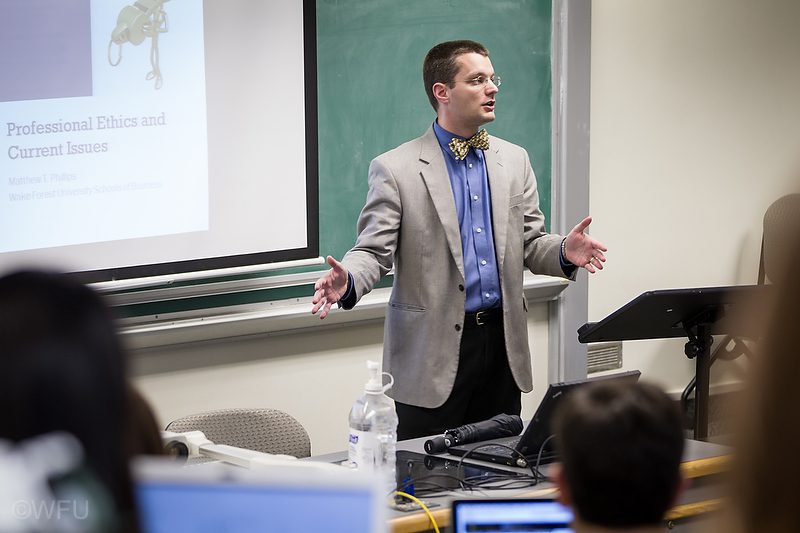
Center fellow Matthew Phillips presented the current draft of the Ethical Decision-Action Model to a group of twenty CFOs and financial executives today in Charlotte in cooperation with the CFO Alliance, a national group with chapters in major cities across the country.
Development of the Ethical Decision-Action Model (EDAM) began in response to a desire among Wake Forest Business faculty to have a consistent approach to ethical issues in classes and case discussions. As development has continued, the Center is working to resource the model to make it a helpful tool for business leaders as well.
Decision tools for ethics are relatively common, but many of the existing models either start at the point when the issue is already isolated (ignoring the difficult tasks of recognizing and categorizing ethical challenges) or end once the decision is reached. The EDAM, as its development continues, will reflect the best research about the conceptual knowledge and preparation that enables decision makers to recognize and approach decisions most effectively, and will also include discrete steps aimed at helping leaders to effectively communicate ethical decisions and consider changes to the systems and processes in their organizations that could keep new ethical issues from arising in the future.
Members of the CFO Alliance in Charlotte heard about the theoretical underpinnings of the model and then shared ethical issues from their own experience. Using those “cases,” the CFOs worked in teams with individual phases of the EDAM model, and then provided feedback to help with the model’s continued development.
A final version of the model is expected in Summer 2014, and the Center is already working on academic support and interactive modules that will make it a useful tool for managers, teachers, and students.